
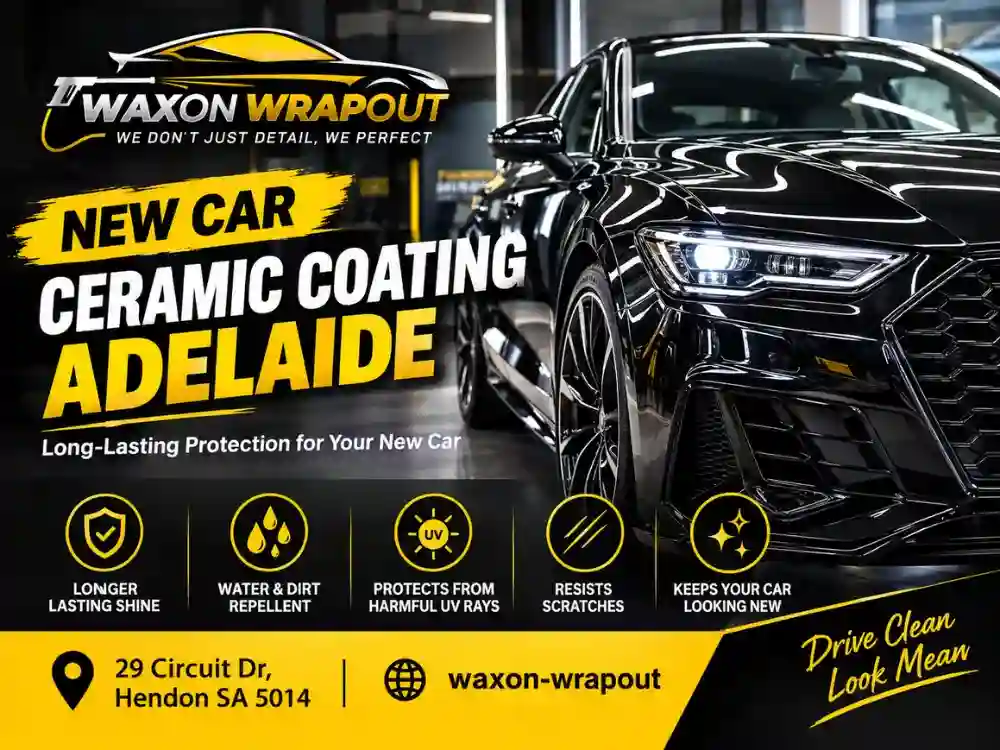
Most people wait. They drive the new car around for a few weeks, enjoy that new-car smell, take it through a couple of car washes, and then start thinking about paint protection. Understandable — but it’s backwards. The best time to get a new car ceramic coating Adelaide is before any of that happens.
Here’s why, and what it actually involves.
Your Car Isn’t As “New” As It Looks
This one surprises most owners. A car that rolled off the delivery truck yesterday has already been through a fair bit by the time it’s in your driveway.
It’s been shipped, sometimes across oceans, protected with a wax-like transport coating that manufacturers apply just to survive the trip. It’s been unloaded, moved around a compound, cleaned up by the dealership, and driven through a pre-delivery inspection. Every one of those steps leaves something behind — a film residue, a light layer of dealership polish or spray sealant, or a few fine handling marks you won’t see standing in the showroom but will see under proper lighting.
None of that is a flaw. It’s just what “new” actually looks like once you get past the surface. The point is: even a brand new car needs a proper decontamination and light prep before a ceramic coating goes on, or the coating ends up bonding to residue instead of the paint — which means it won’t last anywhere near as long as it should.
At Waxon Wrapout, every new-car booking starts with that decontamination step first, no exceptions, regardless of how clean the car looks when it arrives.
Why Not Just Wait a Few Weeks?
Because every week you wait is a week the paint is unprotected against things Adelaide throws at it daily — harsh UV, bird droppings, road grime, the odd automatic car wash with brushes that leave fine swirl marks in the clear coat.
None of that damage happens all at once. It builds up quietly. A car coated on day 3 goes into protection at its absolute best condition. The same car coated at month four already has a bit of that “brand new” gone — nothing dramatic, but nothing you can get back either.
Rule of thumb: book your coating appointment for the same week as delivery, ideally before the car’s first proper wash.
Dealership “Paint Protection” vs a Proper Ceramic Coating
Almost every dealer will offer you paint protection when you’re signing the paperwork. It’s worth understanding what you’re actually being offered before you say yes or no.
A lot of dealer-applied products are consumer-grade sealants — sold under a “ceramic” name but not the same concentration or durability as what a specialist detailer applies. They’re often put on quickly, sometimes without proper decontamination first, and the warranty (if there is one) is usually tied to the dealer, not the product manufacturer — so it may not follow the car if you sell it.
That doesn’t mean every dealer offer is bad. Some are genuinely solid products applied properly. The questions worth asking before you accept (or decline) are simple: What’s the actual product? Who’s applying it, and are they trained on it specifically? Is the warranty backed by the manufacturer or just the dealership?
A professionally applied coating differs in three ways: proper decontamination and prep beforehand, a higher-grade coating applied by someone trained specifically on that product, and a warranty that’s usually backed by the coating manufacturer rather than the dealer.
Picking the Right Level of Protection
Not every car needs the top-tier coating, and not every owner needs the cheapest option either. It generally comes down to how long you’re keeping the car and how it’ll be used.
- Shorter-term ownership: (lease, or you tend to trade in every 2–3 years) → a lighter, shorter-warranty coating is usually enough.
- A typical family car, kept 3–5 years :- a mid-tier coating is the sweet spot for most Adelaide buyers. Enough durability to actually matter without paying for years of protection you won’t use.
- Long-term keeper, or a car you care about resale value on:- The top-tier, longest-warranty coating pays for itself, especially if it’s applied in week one while the paint is still at its best.
Coating, PPF, or Both?
If you’re planning to keep the car for a while, it’s worth thinking about the front end separately. Ceramic coating protects against UV, chemical staining, and makes cleaning easier — but it won’t stop a stone chip. For that, a film (PPF) over the bonnet, bumper, and mirrors handles the physical impact side, with ceramic coating applied over the top of everything, film included, for the chemical and UV protection.
A lot of our new-car customers do both in the same appointment. It’s more efficient than coming back separately, and the car only needs to be off the road once.
Quick FAQ
Do I really need prep work done on a brand new car?
Yes — usually a decontamination wash and a light polish, not a full correction. New cars carry transport residue and light handling marks that most people never notice. Until they’re pointed out under the right lighting.
What if my car isn’t new anymore — is it too late?
Not at all. Coating is worth doing at any stage. It just means more preparation (and a bit more cost) the longer it’s been driven and washed.
Will ceramic coating void my new car warranty?
No. A professionally applied coating doesn’t affect your manufacturer’s warranty — it only affects the paint surface, not anything mechanical.
Can I book before I’ve even picked the car up?
Yes, and it’s actually the smart move — it locks in the appointment for the same week as delivery instead of scrambling afterward.