
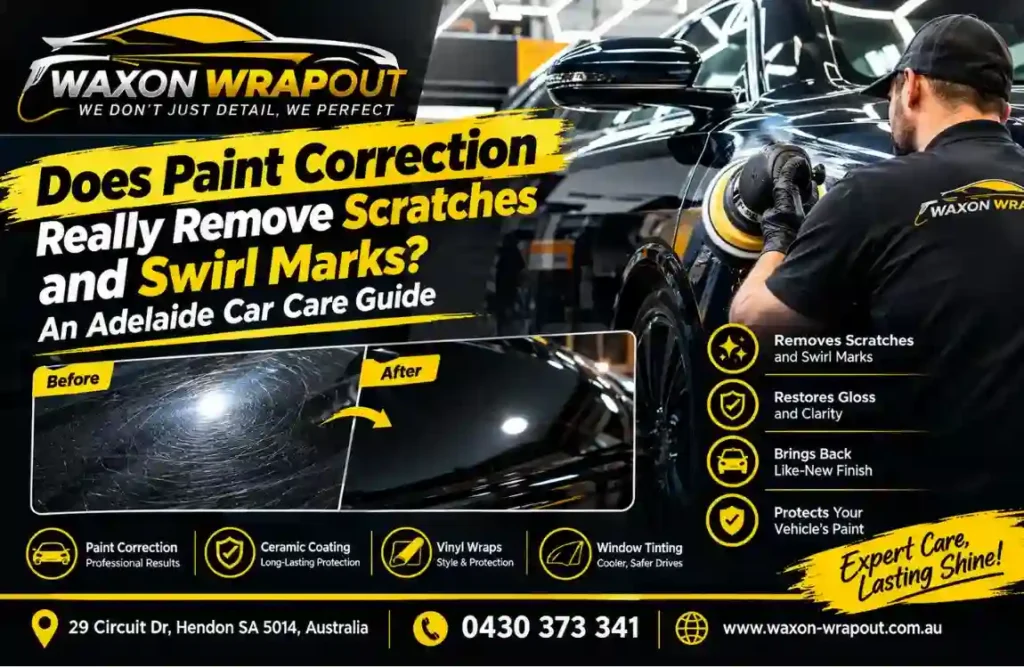
Paint correction removes most swirl marks and light scratches permanently, because it levels the clear coat instead of hiding the damage. What it can’t do is repair a scratch that has cut through the clear coat. Knowing which side of that line your car sits on will save you money and disappointment.
At Waxon Wrapout, we’ve spent 12 years working on Adelaide paintwork from our Hendon workshop. This guide explains what paint correction can fix, what it can’t, and how to tell before you book.
What paint correction actually does
Paint correction is machine polishing that removes a very thin layer of clear coat until the surface is flat again. A scratch is a tiny valley in the clear coat. Light catches its edges, and that’s what you see. Polishing lowers the surrounding surface to the bottom of the valley, and the scratch is gone.
Modern car paint has three layers: primer, the colour coat and a clear coat on top. The clear coat is thinner than a sheet of office paper, and it’s the only layer a detailer can safely work in. That single fact decides everything else in this guide.
Which marks come out, and which don’t
| Paint defect | Will correction fix it? | Why |
| Swirl marks and wash marring | Yes | They sit in the top of the clear coat |
| Light scratches | Usually | Most are shallow enough to level out |
| Holograms and buffer trails | Yes | Caused by poor polishing and removed by proper finishing |
| Water spots and bird-dropping etching | Often | Fresh marks polish out; old, deep etching may only improve |
| Dull, lightly oxidised paint | Yes | Polishing removes the dead surface layer |
| A scratch your fingernail catches in | Improved, not removed | It has gone through or nearly through the clear coat |
| Stone chips | No | Paint is missing, so there’s nothing to level |
| Peeling or flaking clear coat | No | The clear coat has failed and needs a respray |
Swirl mark removal is where correction shines. Those spider-web circles you see under servo lights at night are shallow, and they almost always come out completely.
Two quick checks you can do at home
Run a fingernail lightly across the scratch. If it glides over, the scratch is probably shallow enough to correct. If your nail catches, expect an improvement at best.
Then wet the area. A scratch that vanishes while wet and returns as it dries is a good sign it sits in the clear coat. Neither test is exact, so treat them as a guide and get the paint looked at properly before deciding.
Why a careful detailer measures before polishing
Every pass with a polisher removes a clear coat, and it doesn’t grow back. That makes clear coat correction a job of restraint as much as skill. A professional will usually:
- Check paint thickness with a gauge, panel by panel, to find thin or previously resprayed areas
- Polish a small test spot first to find the gentlest pad and compound that gets the result
- Adjust for paint hardness, since some makes have noticeably softer paint than others
This is also why chasing every last mark is a mistake. Leaving one deep scratch slightly visible is better than thinning the clear coat that protects the whole panel from the sun. If you’re comparing paint correction services in Adelaide, ask each one how they decide when to stop.
How the job is done, step by step
Our approach at Waxon Wrapout follows a simple order: inspect, clean, correct, protect, perfect.
- Inspect. The paint is assessed under strong lighting to map the defects.
- Clean and decontaminate. A thorough wash, then iron remover and clay to lift bonded grit that would otherwise be dragged across the paint.
- Correct. Car paint polishing with a machine, working from a cutting stage to a finishing stage as the paint requires.
- Wipe down and check. Polish residue can hide marks, so panels are cleaned and re-inspected under light.
- Protect. Fresh paint needs a sealant, ceramic coating or film to keep the finish.
How many stages does your car need?
A stage is one full polishing pass over the car. More stages mean more paint defect removal, but also more time and more clear coat used.
A single stage suits newer cars with light swirls and is mostly about gloss enhancement. Two stages, a cut followed by a refinement, handle the moderate swirls and scratches found on most daily drivers. Three or more are for neglected or heavily marked paint, sometimes with careful wet sanding on isolated scratches. The right number comes from the inspection, not from a price list.
What Adelaide does to your paint
Local conditions are hard on a clear coat. Long, hot summers and strong UV dry out and oxidise unprotected paint. Hard tap water and bore-water sprinklers leave mineral spots that etch in if they bake on. Dust acts like sandpaper when it’s wiped off a dry car, and salt air affects cars in the coastal suburbs. Dark colours show all of it sooner.
Correction before ceramic coating, PPF or a wrap
This step gets skipped too often, and it’s the one we care most about as wrap and film specialists.
Ceramic coating. A coating is a clear, hard layer. Whatever is under it stays visible for years, so paint correction and ceramic coating in Adelaide are best booked together. See our ceramic coating and PPF page for how the two work as a package.
Paint protection film. PPF is transparent too. Swirls trapped under film can’t be polished later without removing it, so the paint should be corrected before paint protection film goes on.
Vinyl wraps. A colour-change wrap hides the paint, so full correction usually isn’t needed. Sound, clean paint still matters, though. Chips, rough patches and failing clear coats can show through vinyl or cause it to lift. We check the surface before any car wrapping job and tell you if prep work is worth doing.
What affects the cost and the time
Prices vary because cars vary. The main factors are the size of the vehicle, the condition of the paint, how hard the paint is, the number of stages, and the protection applied afterwards. As a rough guide, a single-stage job is often done within a day, while multi-stage work can take two or three. Be wary of any quote given without seeing the car.
Where DIY polishing goes wrong
You can improve light swirls at home with a dual-action polisher and patience. The risks are real, though. Too much pressure or heat can burn through edges and body lines, where the paint is thinnest. The wrong pad leaves holograms. And without a gauge, you have no idea how much clear coat is left. If the car has been polished before or you plan to coat it, a professional job is the safer choice.
Keeping the swirls away afterwards
Most swirl marks come from washing, so that’s where to focus. Rinse before you touch the paint, use two buckets and a clean microfibre mitt, and dry with a soft towel or a blower. Skip brush car washes. Remove bird droppings and sprinkler spots the same day in summer. A professional detail every few months keeps the finish in check.
Trends in paint correction
A few changes are worth knowing about. Detailers now favour removing as little clear coat as possible, helped by better gauges and finer polishes. Coloured and matte PPF is growing, which makes pre-film correction more important. Some newer coatings and films have self-healing top layers that reduce light marks with heat, though they don’t replace correction of the paint beneath.
Frequently asked questions
Is paint correction permanent?
The defects that are removed are gone for good. New ones will appear if the car is washed badly, which is why protection and good washing habits matter.
How often can a car be corrected?
Only a limited number of times, because each correction removes a clear coat. A well-protected car may need one proper correction and then only light polishing years apart.
Does a new car need paint correction?
Often, yes. New cars can pick up marks during transport and dealer washing. A light single stage before coating or film is common.
Is polishing the same as paint correction?
Not quite. A quick polish adds shine and may fill marks temporarily. Correction removes them by levelling the clear coat.
Can it fix scratches on matte or satin paint?
No. Polishing a matte finish makes it shiny and patchy. Matte paint and matte wraps need different care.
How do I choose when searching “paint correction near me”?
Look for clear before-and-after photos taken under harsh light, ask whether they measure paint thickness, and choose someone who inspects the car before quoting.
Is ceramic coating worth adding afterwards?
For most owners, yes. Ceramic coating in Adelaide’s sun and dust helps the corrected finish last longer and makes washing easier.
Book professional paint correction in Adelaide
If your paint looks dull or swirled, bring it to Waxon Wrapout at 29 Circuit Dr, Hendon. We’ll inspect it, tell you plainly what will and won’t come out, and quote before any work starts. Call 0430 373 341, visit our car paint correction Adelaide page, or send an enquiry.